


Dev Blog #63
Hello, comrades!
Previously in this Dev Blog, we mainly showed elements of the project that shape its overall world, some technical features, and the technology itself. However, the IL2 series has always been and will always be a combat simulator, and "Korea" is not just a project about flying (although we admit that this process has turned out to be very enjoyable), but directly about combat. It’s about how the aircraft, together with the pilot and his skills and knowledge of this aircraft, is tested in extreme combat conditions. It’s about the thrill when everything is at stake, and the outcome can depend on a single accurate shot.
The closer we get to the release, the more we will talk about these things, so today we decided to show you the shooting and its effects in the broadest sense — visual, audio, and physical. We touched on the effects of ground vehicles (and a little bit of aircraft) weaponry early in development in the 16th issue of the diaries, which came out a year and a half ago. Still, since then, we’ve made significant improvements, especially for aircraft.
Previously in this Dev Blog, we mainly showed elements of the project that shape its overall world, some technical features, and the technology itself. However, the IL2 series has always been and will always be a combat simulator, and "Korea" is not just a project about flying (although we admit that this process has turned out to be very enjoyable), but directly about combat. It’s about how the aircraft, together with the pilot and his skills and knowledge of this aircraft, is tested in extreme combat conditions. It’s about the thrill when everything is at stake, and the outcome can depend on a single accurate shot.
The closer we get to the release, the more we will talk about these things, so today we decided to show you the shooting and its effects in the broadest sense — visual, audio, and physical. We touched on the effects of ground vehicles (and a little bit of aircraft) weaponry early in development in the 16th issue of the diaries, which came out a year and a half ago. Still, since then, we’ve made significant improvements, especially for aircraft.
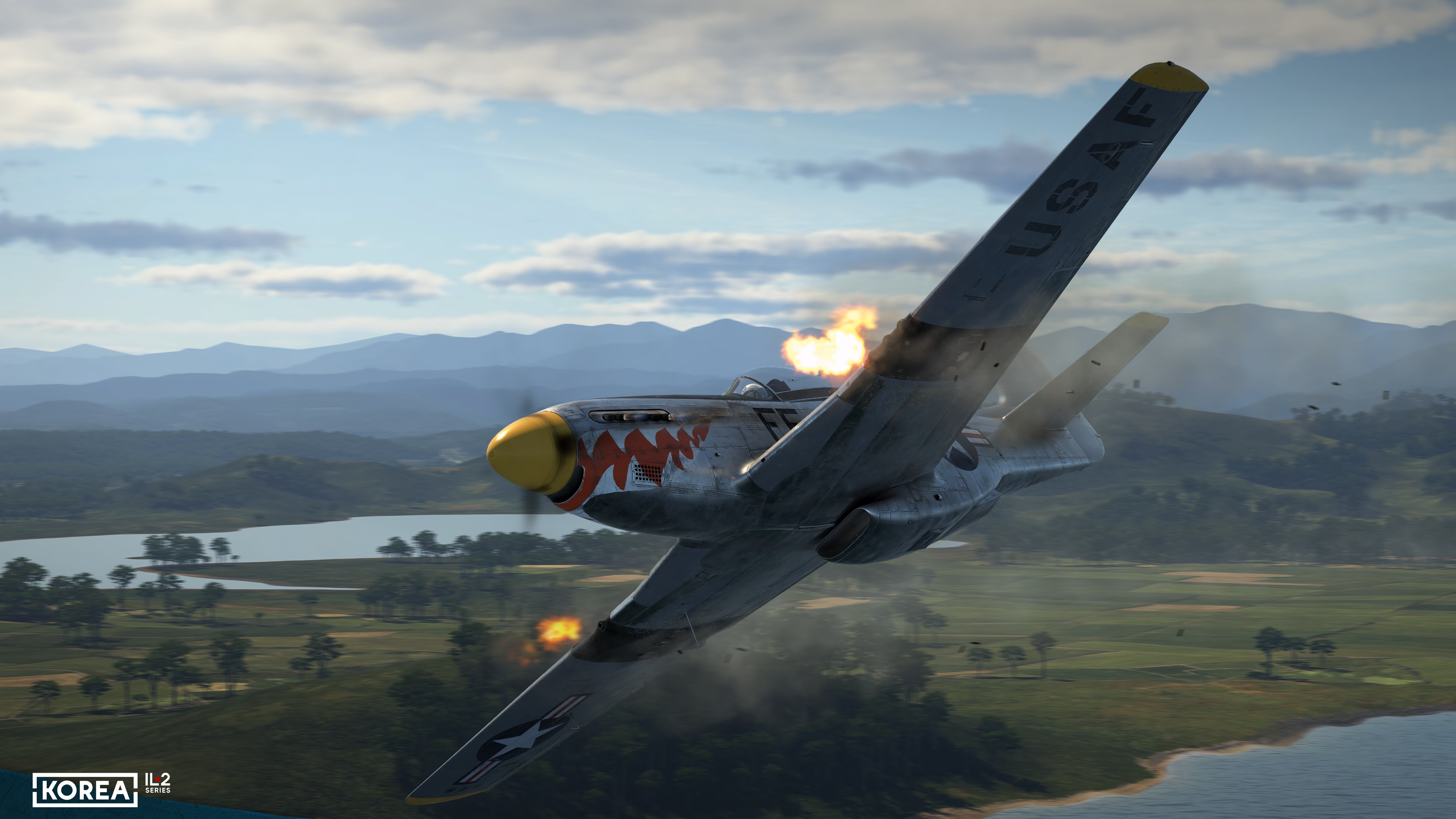
The visual effects of aircraft firing have undergone a long creative journey: the final implementation is the third revision. It was quite difficult to find the right look for the effects and balance them with performance: we had to take into account both realism and technical limitations. After all, in a battle in the skies over Korea, about 200 aircraft can fire simultaneously, each of which has way more than one gun, not to mention ground equipment. All of this has to work well on the players' personal computers. In many ways, the more realistic appearance of the effects was made possible by the refinement of the graphics effects system last year — it took time to unlock the potential of these technologies. A new particle texture animation system, a new effects lighting system, the use of new tools and artistic approaches — take a look at the result. The scale, dynamics, shapes, and textures of gunfire flashes, as well as certain features of physical processes, have all been reproduced with the utmost care and quality possible at this technological stage.
The sound of gunfire has also undergone several iterations: a year and a half ago, it was already good, but we weren’t satisfied with the result, so we went even further in our research, both in terms of reference data and in modernizing our sound design approaches. The use of the latest version of the FMOD sound engine API, with its expanded capabilities for creating sound compositions, and a reassessment of our previous experience with sound, enabled us to develop new schemes for the sound of aircraft guns firing. They take various factors into account in a completely new way. Gunfire from the cockpit sounds fundamentally different from outside — the shots themselves are muffled, there are no longer reverberations or echoes, and at the same time, the sounds of the aircraft’s structure vibrating are added. The effect of the weapon’s power (caliber) on the audible sound of shooting in the cockpit is completely different from that outside. Even the location of the guns matters — this factor has also been taken into account.
The external sound has also been completely redesigned, using new data that has become available to us over time. The effect of distance on the sound of gunfire has become even more significant. Browning M2 and M3, ShKAS, UB, ShVAK, VYA-23, NS-23, NR-23, N-37 — all of the aircraft guns in Korea have a unique, recognizable sound.
When it comes to the physical effects of shooting, the main thing here is recoil. Many people asked, "Will recoil visibly affect the aircraft?" To answer this question, we decided to show you a short video demonstrating how far the MiG-15 recoils when firing its main caliber. You can see that the aircraft does not simply pull back while firing, as would be simplistically done in other games. No, you can see powerful jolts from each shot, applied not simply to the center of mass of the aircraft, but to the axis of the gun trunnions. This results in aircraft not just recoiling backward, but also turning slightly with each shot. Of course, the mechanical processes in the weapons are also simulated — the weapon’s automatic systems, synchronizer gears in piston aircraft, and main and backup reloading mechanisms are all taken into account. The barrels overheating during long bursts have been revised, as has how this depends on airspeed and barrel location. Overheating can not only reduce muzzle velocity and increase spread, but also cause misfires. And this is in addition to the new features for managing ammunition belts and new ammunition types, which we discussed earlier.
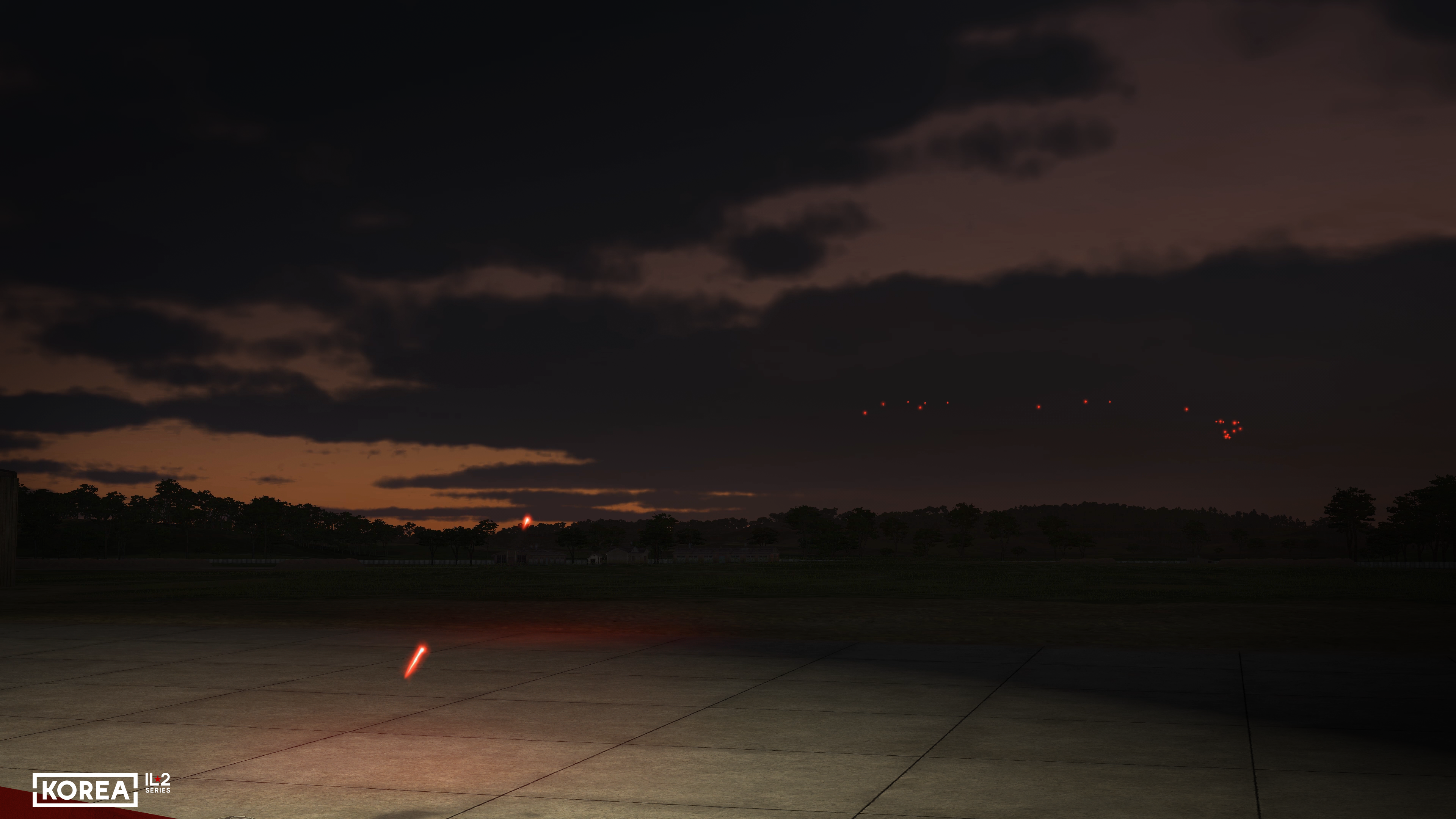
Speaking of shooting effects, we cannot fail to mention light tracers: we have also reviewed and completely redesigned them. In general, this is one of the most difficult effects to implement, since the number and speed of bullets impose very tight constraints on effect design. Still, we have found excellent approaches that have enabled us to achieve a new, excellent result here as well. Tracers now not only glow, but also illuminate objects they fly close to. This will be clearly visible on bullets flying along the ground, as well as when your plane is attacked by the enemy late at night or in the evening, and bullets whiz over your cockpit. Moreover, tracers will cause an additional incendiary effect when they hit combustible parts of aircraft (although less significant than specialized hollow core incendiary bullets) — more on this below.
An interesting observation — after carefully studying real recordings, we concluded that the "smokeless" tracers characteristic of American weapons are actually rather low-smoke, that is, there is some smoke trail from any tracer shell or bullet, but in this case, it is almost transparent and not so noticeable — and this was also reconstructed in "Korea." Regarding smoke, it is also worth noting new approaches to its formation: the smoke from tracers now curls more naturally and matches real guncam recordings as closely as possible.
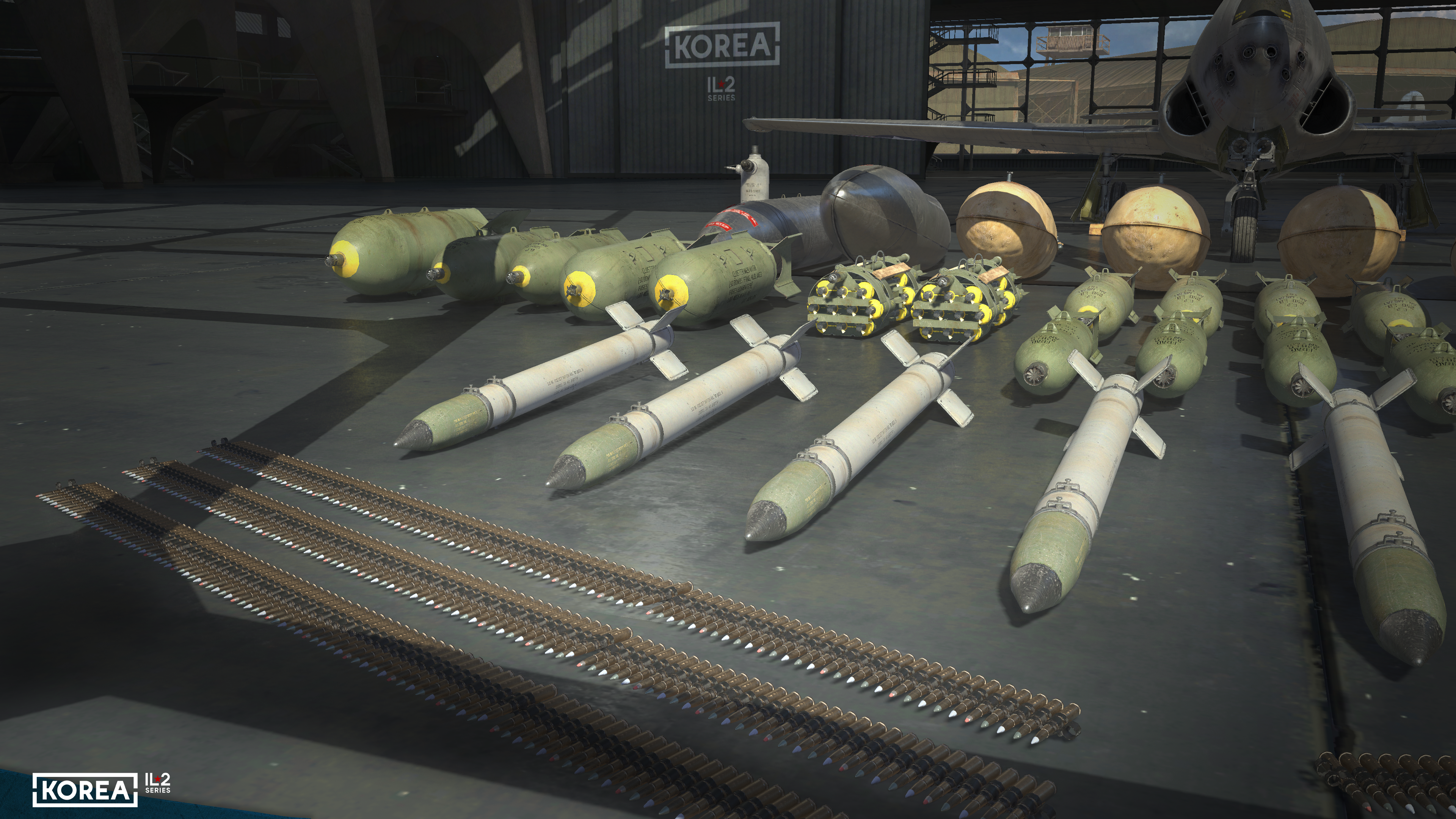
The game features the following cartridges and shells for aircraft guns:
- 12.7 mm Armor-Piercing-Incendiary (A.P.I.), Cal.50, M8
- 12.7 mm Armor-Piercing-Incendiary-Tracer (A.P.I.T.), Cal.50, M20
- 12.7 mm Incendiary, Cal .50, M1
- 20 mm Armor-Piercing-Tracer cartridge (A.P.T.), M95
- 20 mm Incendiary cartridge, M96
- 20 mm High-Explosive-Incendiary (H.E.I.) cartridge, M97
- 7.62 mm Armor-Piercing-Incendiary, “B-32”
- 7.62 mm Armor-Piercing-Incendiary-Tracer, “ZB-46”
- 7.62 mm Incendiary-Tracer, "PZ"
- 12.7 mm Armor-Piercing-Incendiary, "B-32" (yes, it has the same name as the 7.62 mm type)
- 12.7 mm Armor-Piercing-Incendiary-Tracer, “BZT-44”
- 12.7 mm Instant Action Incendiary, "MDZ-Z"
- 20 mm Armor-Piercing-Incendiary, “BZ”
- 20 mm High-Explosive-Fragmentation, "OZ Variant 2"
- 20 mm High-Explosive-Fragmentation-Incendiary, "OZ Variant 1"
- 20 mm High-Explosive-Fragmentation-Tracer, “OZT”
- 23 mm Armor-Piercing-Incendiary, “BZ”
- 23 mm High-Explosive-Tracer, “OZT”
- 37 mm Armor-Piercing-Incendiary-Tracer, “BZT”
- 37 mm High-Explosive-Tracer, “OZT”
In conclusion, let’s note the effects of various types of bullets and shells. Armor-piercing incendiary bullets carry an explosive incendiary compound that ignites combustible materials at the point of impact, but the armor-piercing core of such a bullet continues to move inside the target without incendiary effect. Hollow-core incendiary bullets are the most effective ammunition in terms of ignition: the composition contained in the core cavity continues to have an incendiary effect on everything that the core encounters on its path inside the target after the initial impact, but such a bullet has much less penetrating power. Armor-piercing tracer bullets, if the tracer is still burning at the moment of impact, also have a noticeable effect on elements along their path. High-explosive fragmentation shells hit the aircraft with a shock wave and fragments, as their name suggests, and also have some incendiary effect near the point of impact. In a high-explosive fragmentation incendiary shell, the explosive effect is slightly reduced in favor of the incendiary one.